happy retired couple

Is £1 million enough to retire?

Retiring with a pension pot of £1 million

As retirement approaches, those who have diligently saved to build a considerable nest egg ponder, is £1 million enough to retire comfortably?.
With rising living costs and longer life expectancies, understanding the true value of your pension is more important than ever. This article highlights what a pension pot of £1 million means in today’s financial landscape and offer insights that can help you secure the retirement lifestyle you desire.

What does having a pension pot of £1 million mean?

Having a pension pot of £1 million may sound substantial, but it’s essential to put it in context. For many, this amount can represent years of hard work and saving, in the hope that £1 million would be enough to retire, but with increasing life expectancies and inflation, its purchasing power may not stretch as far as you think.

How are (most) pensions split?

Any growth, income, dividends, interest inside the pension are tax-free, but when you spend some of the pension, the income withdrawn from the plan may be liable to income tax. So, unfortunately, you will lose some of the £1 million to tax.
Usually, 25% of the pension is tax free, with the remaining 75% taxable. So, for a pension pot of £1 million…

Example pie chart of a £1 million pension pot taxable and tax free split.


Cost of living in retirement

Breaking down expenses

As you plan for retirement, it’s vital to consider the typical expenses you might face. On average, a retired couple needs £59,000 a year for a ‘comfortable’ standard of living. Another often quoted figure is to aim for 70% of your current annual income, the assumption here being people spend around 30% less when they stop working.
Whilst these averages may be a useful starting point, the only figure that matters is how much you need to live the retirement you’ve so worked hard for.
From our experience as Independent Financial Advisors in Cirencester, we find that spending in retirement is rarely linear. Often, clients spend more during early retirement and less later in life, followed by a big spike if care fees are required. Of course, things like paying for weddings, contributing to a family members pension, or helping with house deposits skew spending patterns and must be budgeted for.

Your personal rate of inflation

Inflation can erode your pension pot of £1 million over time. Whilst the average inflation rate is known, it’s essential to consider your ‘personal’ rate of inflation, i.e., how much the cost of goods and services you buy increases each year.
Your personal rate of inflation impacts how long your pension pot of £1 million will last for and is important when considering, is £1 million enough to retire, as retirement approaches. The Office of National Statistics (ONS) provides a useful calculator to work out your personal rate of inflation.

The longevity factor

In the UK, the average life expectancy for men is around 79 years and for women, about 83 years. With average life expectancy increasing, many retirees could spend 20-30+ years in retirement. This longevity can strain a pension pot of £1 million if not planned for.
This chart shows the life expectance of a 60-year-old couple. There is a 50% chance at least one of them lives to age 93.
Click to enlarge
Source: Timeline.co
Understanding longevity trends helps you plan for retirement more effectively, ensuring your pension pot of £1 million can support you through a longer retirement.

Let’s talk about risk

One of the key factors that influence the longevity of your pension and whether £1 million is enough to retire, is the combination of growth assets (like global stocks) and defensive assets (such as bonds and cash) in your portfolio.
Since retirement can last 30 years or more, taking too little risk might mean you run out of money sooner than expected. Balancing a diverse investment portfolio with both growth and defensive assets can help your pension combat the challenges of longevity and inflation.
Here is a graph showing how Global Equities (a popular growth asset), global bonds (a popular defensive asset) performed over the last 30 years compared with UK inflation and cash savings.
Graph showing how global equities (a popular growth asset), global bonds (a popular defensive asset) performed over the last 30 years compared with uk inflation and cash savings.
Click to enlarge
Key takeaways from this are:
  • equities beat bonds but was more volatile
  • bonds beat cash and inflation
  • cash deposits are not always higher than inflation so keeping cash in the bank over a long period of time might not be as safe as you think

Workplace pensions

A lot of workplace pension schemes automatically shift investments into defensive assets as retirement nears. This is meant to protect your savings from market ups and downs, but it might not be the best move for everyone.
Low-risk investments may not bring in enough returns for a long retirement. So, it’s vital to ensure your pension investments align to your appetite for investment risk and are set-up to benefit from long-term growth.

Other income sources in retirement

While pension advice is a crucial piece of the puzzle, it’s important to consider other income sources and any potential windfalls.
Other income sources factored-in to your plan impacts how much you need to withdraw from your pension pot of £1 million,how long it will last and ultimately influence the question; is £1 million enough to retire?
Other income sources include, State Pension, investment portfolio, rental income, part-time or consultancy work, bonuses from work inheritances. It’s crucial to understand how much ‘other’ income you’ll receive in retirement and how long this will last.

Financial modelling: Predicting your pension longevity

Introduction to financial modelling

Financial modelling can provide personalised insights into how long your pension might last based on various assumptions. This data-driven approach allows you to see potential scenarios tailored to your financial situation.
Below we look at a case study of an imaginary couple approaching retirement with a pension pot of £1 million.
Case study
  • Joe & Josephine Public
  • Age 60, retiring at 65
  • Joe has a pension pot of £1million, invested in an equal split of growth and defensive assets
  • Target retirement spending: £59,000 each year increasing by inflation
Our software models hundreds of different retirement journeys throughout the last 109 years of history. Based on their circumstances, their plan is less sustainable.
Graphic showing a less sustainable pension plan
Click to enlarge
This means if Joe & Josephine started retirement at any point in the last 109 years, they wouldn’t have ran out of money 59% of the time (but they would have 41% of the time!)
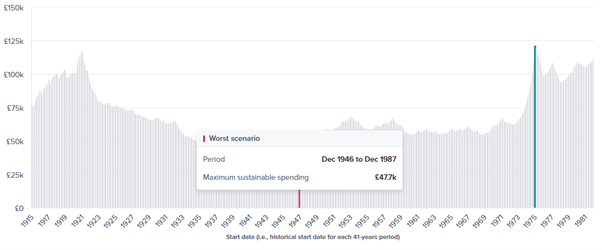
Here are the retirement simulations lined up; each one of these lines is a 41 year retirement period and calculates how much Joe & Josephine could’ve spent.
Best case scenario – January 1975 to January 2016: They could’ve spent £121,000 per year and never run out of money!
Example of a best case scenario from 41 year retirement period calculating how much joe & josephine could’ve spent. January 1975 to january 2016: they could’ve spent £121,000 per year and never run out of money!
Click to enlarge
Worst case scenario – December 1946 to December 1987: They could have only spent £47,000 per year if they retired then.
Example of a worst case scenario from 41 year retirement period calculating how much joe & josephine could’ve spent. December 1946 to december 1987: they could have only spent £47,000 per year if they retired then.
Click to enlarge
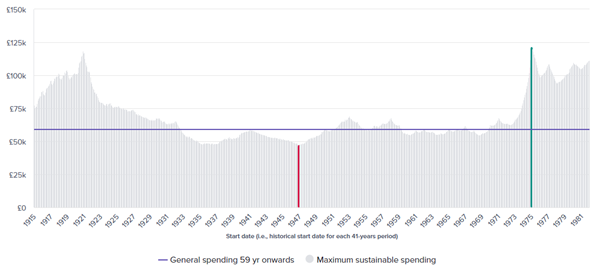
Graph showing target retirement income across a number of years
Click to enlarge
Blue line is £59,000 per year: their target income amount.

How can they improve their chances of success and have enough to retire at 60?

If Joe and Josephine felt that the probability of running out of money is too high here’s some ways that could’ve improved their odds of never running out of money.

1. Check the risk profile

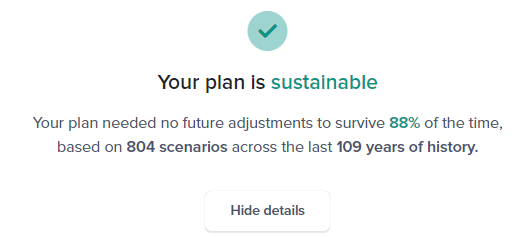
A modest increase to the amount of growth assets (equities) in Joe’s pension increased the prospects considerably…
A sustainable retirement plan
Click to enlarge

2. Review charges

No pension advice or investment is free but excessive charges can erode the value of Joe’s pension over a long retirement.
Sense checking whether the fees are reasonable and, importantly, represent good value for money is sensible to do.

3. Dynamic spending

Will Joe and Josephine spend less in their 80s? If they’re less likely to travel, for example. Their spending may not be linear, so a bespoke model tailored to their retirement plans can account for a dip in spending later in life. This may improve their prospects and free up more cash to spend at the start of retirement.

4. Inflation rules

In their plan Joe & Josephine’s annual spending is assumed to increase every year. Establishing rules such as forgoing an increase in income in a year when the pension suffers a dip could improve the sustainability of the pension.
Agreeing to such rules at the start of the retirement journey is sensible. An independent financial adviser can work with you to agree these at the outset, monitor whether the plan veers off-track and recommend remedial action.
Images courtesy of our software, Timeline.co

Sounds like a plan…

This is a basic example. Our clients’ retirement plans are much more colourful than Joe & Josephine’s, so umpteen variables and ‘what-if’ examples must be considered.
A solid financial plan should:
  • Provide peace of mind – with the caveat that this isn’t a crystal ball
  • Be built on prudent and realistic assumptions, otherwise you’re just kidding yourselves
  • Be flexible. life happens so plans must have an element of mailability to survive the long-term.

Professional independent financial advice Cirencester

Navigating retirement finances can be daunting. A personalised financial plan can provide clarity and confidence, ensuring your pension pot of £1 million works hard for you and keeps you on track to enjoy the retirement you’ve worked so hard for.

How Abode Financial Planning in Cirencester can help

Over the years, we’ve helped countless families articulate what a perfect retirement looks like, from wanting to retire at 50, to discussing pension contributions for high earners, we design a plan to bring this to life. It’s what we do best.
As your personal financial sidekick, we’re here to guide you through the complexity of retirement planning.
Contact us today to discuss how far your pension will take you.

Download your pension guide for high earners and company directors​

Frequently asked questions

It depends on your lifestyle, spending habits, and how long you live. With professional pension advice Cirencester, you can assess if £1 million aligns with your retirement goals.

The income depends on understanding your pension options which can include; withdrawal rate, investment returns, and whether you opt for annuities or drawdown. Typically, a £1 million pot could provide £40,000–£50,000 annually, but this can significantly vary.

Key factors include your spending habits, inflation, investment growth, investment fees and unexpected expenses like healthcare.

Over time, inflation erodes the purchasing power of your money. It’s essential to factor in inflation and consider growth-focused investments to maintain your pension’s value.

It depends but, taking it as income through drawdown or annuities is generally more sustainable and can save a huge amount of tax. An independent financial adviser can guide you on the most tax-efficient option.

The 4% rule is based on a study which suggests withdrawing 4% annually is a sustainable withdrawal rate for a typical retirement length. However, market fluctuations and personal circumstances may require adjustments.

Careful financial planning, diversified investments, and regular financial planning reviews can help you manage your pension for the long term.

Yes, pensions can be passed on tax-free if you die before 75. After 75, beneficiaries may pay income tax on withdrawals. From April 2027, pensions may be liable to Inheritance Tax too. Proper retirement planning ensures your legacy is maximised.

The state pension provides a baseline income to supplement your private pension, helping stretch your £1 million further.

Navigating tax rules, managing investments, and planning withdrawals can be complex. Seeking pension advice Cirencester ensures your pension is optimised for your unique needs.

Investment risk information

Please note, the value of investments, and the income from them, may fall or rise and investors may get back less than they invested.

This information is for general information only and does not constitute advice. The information is aimed at retail clients only.

Past performance is not necessarily a guide to future performance.

You might also be interested in...


Pension contributions for high earners

At a glance The standard annual allowance is £60,000 for 2026/27.High earners may have a lower allowance if threshold income is...

Read more

How to reduce an Inheritance Tax…

At a glance Inheritance Tax is usually charged at 40% on the part of your estate above your available allowances. The main...

Read more

Understanding the pension lifetime allowance changes

At a glance The Lifetime Allowance (LTA) has been abolished. There’s no overall cap on the size of your pension...

Read more

Independent financial advisor Cirencester, financial advice for business owners and company directors in Cirencester

Abode Financial Advisers is an Independent Financial Advisor in Cirencester.
Abode Financial Advisers is a financial adviser based in Cirencester, Gloucestershire. Abode Financial Planning is an independent financial advice firm offering comprehensive financial planning services, including: independent financial advice, retirement planning, pension advice, investment advice, wealth management, and inheritance tax planning.
If you wish to discuss your situation, contact us for a no-obligation initial call, held at our expense. Call us on 01285 703 060.