
How we keep this page current: We review this guide at least every six months, or sooner after pension, tax or FCA rule changes.
At a glance
- If you are 50 to 65 and have several pension pots, combining them may help you get a clearer view of retirement.
- Combining pensions, also called pension consolidation, can make pensions easier to track and manage.
- Some old pensions include valuable benefits that may be lost if you transfer.
- Final salary pensions need special care and should not be moved without advice.
- A good decision starts with checking each pension before you combine anything.
This guide gives you the big picture: what combining pensions means, when it may help, and when to pause. Our next guide which is coming soon, “Multiple pension pots? What to check before you consolidate”, will look at the detailed checks to make before moving a pension.
Why do people end up with several pension pots?
Most people do not set out to collect pensions. It happens over time.
You may have changed jobs, joined different workplace pension schemes, set up a personal pension, run your own business, or paid into a director’s pension. By your fifties or early sixties, the paperwork can feel scattered.
A typical working life often creates more pension pots than people expect.
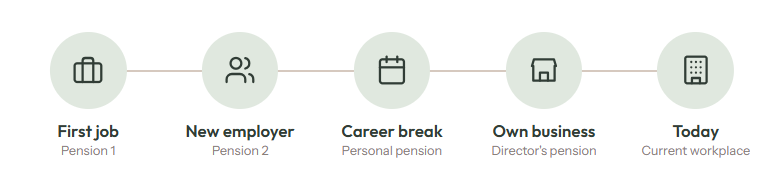
That matters because old pensions are easy to lose track of. The Pensions Policy Institute estimated in 2024 that there were 3.3 million lost pension pots in the UK, worth £31.1 billion. The average lost pot was highest among people aged 55 to 75.

If you are approaching retirement, this is a good time to get organised. You do not need every pension in one place, but you do need to know what you have.
How to find old pensions
Start with a simple list.
Write down every employer you have worked for, any personal pensions you remember, and any old addresses linked to those plans. Then check payslips, annual statements, emails and old tax paperwork.
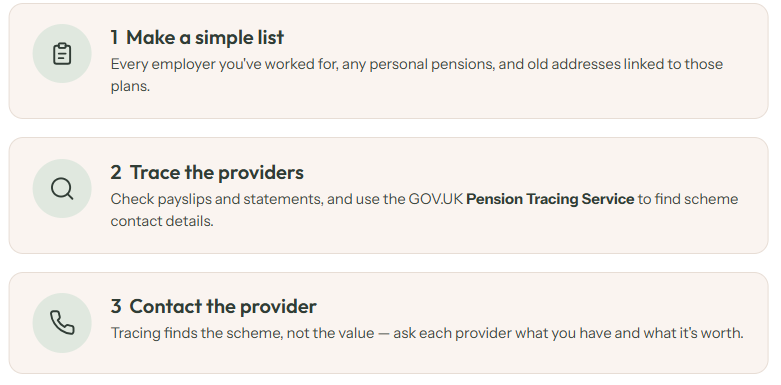
MoneyHelper suggests listing all the places you have worked, finding the provider’s name, using the Pension Tracing Service, then contacting the provider directly.
GOV.UK’s Pension Tracing Service can help you find contact details for workplace and personal pension schemes. It cannot tell you whether you have a pension or what it is worth, so you still need to contact the provider after using it.
What does combining pensions mean?
Combining pensions means moving two or more pensions into one pension.
This usually applies to defined contribution pensions. These are pensions where money has been paid into a pot, then invested. The value depends on contributions, charges, investment returns and how you take the money later.
Combining pensions may give you:
- fewer providers to deal with,
- one clearer investment strategy,
- easier income planning,
- fewer statements and logins,
- a better view of your retirement position.
Transferring a pension may mean lower fees, different withdrawal options and the chance to bring schemes together, but you may lose valuable benefits that only your current provider offers. MoneyHelper
That is the main point. Combining pensions can help, but checking first matters more.
What pension consolidation can look like
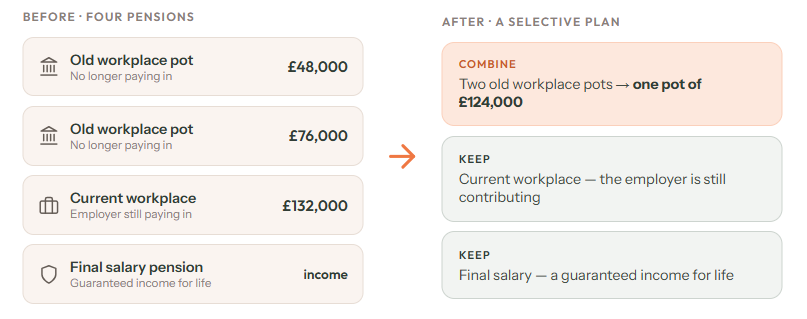
Here’s a simple example of how several pension pots can become easier to organise.
Every pension is different. Before deciding whether consolidation might be suitable, ask yourself these questions.

When combining pensions may help
Combining pensions often works best when you have several straightforward defined contribution pensions from old jobs.
It may help if:
- you want a clearer retirement plan,
- an old pension has high charges, or poor performance
- a newer pension gives better income options,
- your existing pension funds no longer suit your plans,
- you want fewer accounts for you and your family to manage.
For many people in Cirencester, the Cotswolds and across Gloucestershire, this question comes up when retirement starts to feel close. You may want to reduce work, sell a business, support children, travel more, or understand whether you have enough.
At that stage, pension consolidation should be part of wider financial planning. The real question is not just, “Can I combine these pensions?” It is, “Will this help me retire with more clarity and fewer unwanted surprises?
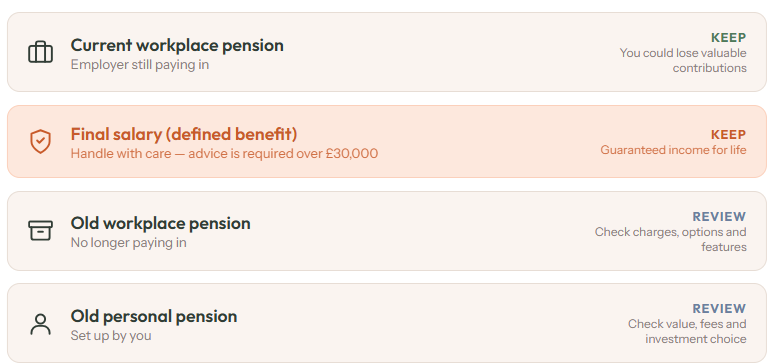
It’s also important to remember that not every pension should be moved. Some are often better left exactly where they are because they provide valuable benefits that could be lost after a transfer.
Pension consolidation checker

When you should pause before transferring
Some pensions have valuable features that may be lost if you transfer. They do not always stand out on a pension statement, so check before moving anything.
Pause if the pension includes, or might include:
- guarantees (like a guaranteed annuity rate),
- protected tax-free cash,
- a protected pension age,
- with-profits benefits,
- exit charges,
- ongoing employer contributions.
These details can change the answer. One pension may be worth combining, while another may be better left where it is.
For a deeper checklist, read our next guide coming soon: Multiple pension pots? What to check before you consolidate.
Be careful with final salary pensions
Final salary pensions are also called defined benefit pensions.
They are different from pension pots. They usually promise an income for life, often with yearly increases and benefits for a spouse or dependant.
The FCA and The Pensions Regulator believe most people are best off keeping a defined benefit pension. A transfer cannot be reversed, so people need to understand the risks before deciding.
Advice in this area is complex. Defined benefit pension transfers need specialist resources, and advice has been mandatory for transfers valued over £30,000 since pension freedoms began in 2015. FCA.
For many people, a final salary pension forms the secure base of retirement income. Other pensions, ISAs and cash can then sit around it
A simple checklist before combining pensions
A retirement ready plan is clear, practical and personal. It should help you make decisions before pressure builds.
Use this before you move anything.
| First check | Why it matters |
|---|---|
|
What type of pension is it? |
Some pensions are simple pots. Others promise income or include guarantees. |
|
Is anyone still paying into it? |
Moving an active workplace pension may stop employer contributions. |
|
Does it have special benefits? |
Guarantees, protected tax-free cash or protected pension ages may be lost. |
|
Does it fit your retirement plan? |
The right choice depends on income, tax, spending and family goals. |
This checklist keeps the decision practical. It also helps avoid the common mistake of treating pension consolidation as an admin task.
A simple example
A 59 year old professional in the Cotswolds has four pensions:
- two old workplace pension pots,
- one current workplace pension,
- one small final salary pension.
At first, combining everything looks simpler.
After checking the details, a better answer may be more selective. The two old workplace pensions might be suitable to combine. The current workplace pension may stay where it is because the employer still pays in; this can be revisited when they retire and the contributions stop. The final salary pension may stay separate because it provides a guaranteed income for life.
The paperwork is simpler, but the valuable parts are protected
How Abode Financial Planning can help
Abode Financial Planning is an independent, Chartered financial planning firm based in Cirencester.
We help people approaching retirement understand their pensions before making big decisions. We contact providers, check pension details, review charges and investments, look for guarantees, and explain the options in plain English.
Then we help you answer the questions that matter:
- Which pensions should I keep?
- Which pensions might be worth combining?
- How much can I spend in retirement?
- Which pension should I use first?
- How can I take income without paying more tax than needed?
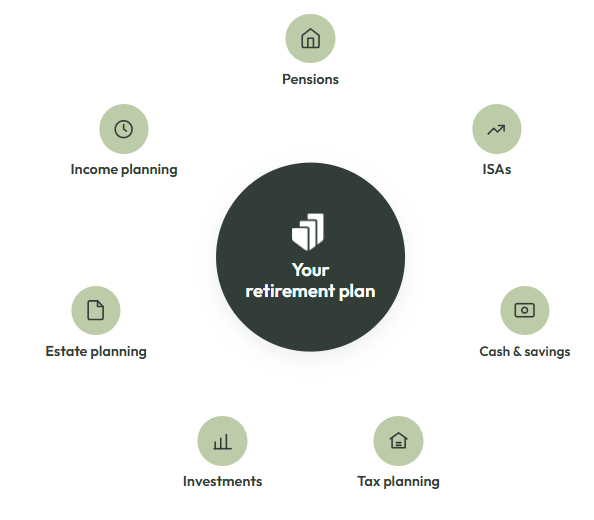
Pension consolidation can be useful, but it is only one part of retirement planning. Good planning brings together pensions, ISAs, cash, tax, investments, family goals and future spending.

Frequently asked questions
It can be, but only after checking each pension. Combining pensions may reduce paperwork and improve retirement income options, but you may lose valuable benefits if you move the wrong plan.
You can often combine defined contribution pensions. Final salary pensions, active workplace pensions and pensions with guarantees need extra care first.
A normal transfer between UK registered pension schemes does not usually create a tax charge. Tax becomes more important when you take money out or if you lose protected benefits.
Be careful. If your employer still pays into it, moving the pension may stop those contributions.
Not always, but advice is often sensible. It is especially important where you have defined benefit pensions, guarantees, protected tax free cash, large pension pots or uncertainty about retirement income.
Book an initial call
If you are approaching retirement with several pension pots, Abode Financial Planning can help you understand your options before you move anything.
Book an initial call with our Cirencester team. We will help you understand what you have, what needs checking, and what may be worth combining.
Contact Abode Financial Planning:
Call: 01285 703 060
Email: hello@abodefinancial.co.uk
Office: Watermoor Point, Watermoor Road, Cirencester, GL7 1LF
Important information
This article is general information, not personal advice. Pension and tax rules can change, and the right choice depends on your circumstances. The value of investments can fall as well as rise, and you may get back less than you invest. Seek regulated financial advice before transferring, combining or taking money from a pension.
You might also be interested in...

A Guide to Combining Pensions Before…
How we keep this page current: We review this guide at least every six months, or sooner after pension, tax...
Read more
Financial planning mistakes business owners make…
At a glance A retirement ready business owner has a clear exit route, personal wealth outside the business and a...
Read more
Pension contributions for high earners
At a glance The standard annual allowance is £60,000 for 2026/27.High earners may have a lower allowance if threshold income is...
Read more